
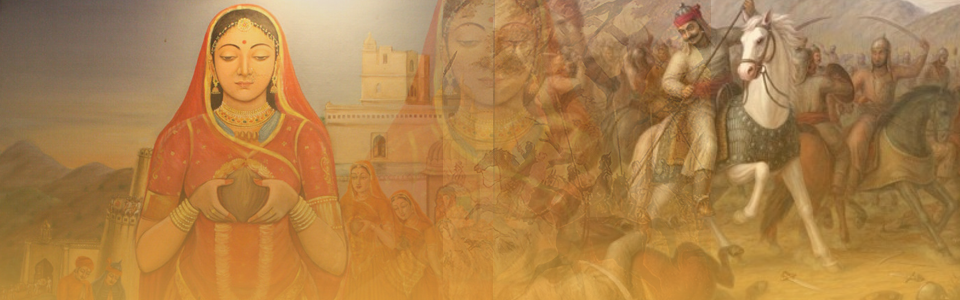
Jauhar Shaka — When The Enemy
Was At The Gate
If there is one ritual that epitomises heroism, defiance and conjugal love in the face of brutal onslaughts on Rajput kingdoms, it is Jauhar-Shaka. When the enemy was at the fort gates, when rations ran out, and when defeat was certain, Rajput kingdoms followed a code of honour that inspires awe and dread to this day.
All the women within the fort, led by queens dressed in their wedding fineries and jewellery, along with children, would step into a large fire and turn to ashes in a ceremony called Jauhar before the enemy set upon them.
“While the women burned, the Rajput men performed the Shaka — the last fight from which there was no return.”
The fort gates would be thrown open and the men, dressed in kesariya (saffron) — the Hindu colour of renunciation — with tulsi leaves in their mouths, would charge into the enemy with the singular aim of killing as many as possible before falling themselves.
The Code of Honour
For the Raajput warrior, death in battle was infinitely preferable to surrender or captivity. The Rajput Dharma demanded that a warrior fight to the last breath, and that his family be protected from dishonour at any cost.
The most famous Jauhar was performed at Chittorgarh in 1303, when Rani Padmini led the women of the fort into the sacred fire as Alauddin Khilji’s forces breached the walls. The Rajput men then performed the Shaka, charging into battle in their thousands.
Three Great Jauhars of Chittorgarh
- First Jauhar (1303) — When Alauddin Khilji besieged Chittorgarh, Rani Padmini led 1,600 women into the sacred fire.
- Second Jauhar (1534) — Rani Karnavati led the women when Bahadur Shah of Gujarat attacked. She also famously sent a rakhi to Emperor Humayun asking for protection.
- Third Jauhar (1568) — The final Jauhar, when Akbar conquered Chittorgarh. Over 8,000 Rajput warriors performed the Shaka that followed.
Jauhar in the Rajput World View
It would be a mistake to view Jauhar through a purely modern lens. For the Rajput society of medieval India, Jauhar was an act of supreme dharma — the fulfilment of the warrior’s ultimate duty to protect the honour of his family and kingdom.
The flames of Jauhar became a symbol of Rajput pride that has endured for centuries. The Jauhar Mela held at Chittorgarh every year draws hundreds of thousands of Rajputs from across India and the diaspora to honour this sacrifice.
For the Raajput, honour was not merely a virtue — it was the very foundation of existence. Jauhar-Shaka stands as eternal testimony to that truth.